Posts

Building the Parametric Shelf

Image
It's finally time to bring this shelf to life! The bases are each in one solid piece and will be laser cut out of MDF. The planks will also be laser cut out of MDF. The poles will be 3D printed. The sections where the poles attach will be created by "etching" them with the laser cutter. We will have to do one side, then flip the board over and line it up to do the other. I think this is the best way to ensure sizes are accurate, especially since there are so many. Here are the final 3 iterations of this design: Here are some photos of the pieces being made: First the poles were printed. Here are the planks being made. We started by etching the indents on one side, then flipping the board over, etching the indents on the other side, then finally cut the pieces out. There were some issues with this method. The main one being the accuracy of the depth of the etched indents. Some indents were too deep, affecting the integrity of the MDF. Going fo...
Parametric Shelf Algorithm COMPLETE!!

Image
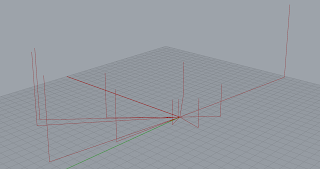
After several weeks, I have FINALLY finished my parametric shelf design. It took several tries to figure out the right way to build the algorithm into one that created a logical form. Below I have broken down exactly what I did. POLES First I began by creating lines that rotated randomly around a single point. I made their lengths random as well. I took the end points of those lines, and used them as the centre points of the poles. The heights were also randomized.   This section gives the poles their form using circles with random radii that are extruded and capped. SHELVES At the top of each pole, using its end point, I created another line on the XY plane. Each one has a random length and a rotation. I used the end points of these lines as the centre points of the shelves.   The shelves are all made from circles with random radii. The all have the same thickness. By tweaking the range of radii as well as the range fo...

Update on Parametric Shelf

Image
I spent much of my time reworking the algorithm in order to simplify it as well as built upon it more efficiently. I started with the poles. I was able to give them random radii and lengths as before, and place them randomly in space. I then gave each one a shelf, all with random radii.  I also set up another set of poles, offset from the center of each shelf. From there I decided it was best to bring everything down to 0 on the z-axis to make the shelf more sturdy. I also added another layer of shelves. This is the algorithm as it currently stands: Here is where I'm stuck. I would like to ensure the all my shelves are attached in one piece. They all are except one. I spent a lot of time exploring the split list function, trying to find a way to attach one shelf to the next but couldn't quite figure it out. I'm sure it's super simple but I'll have to consult my teacher.

Bringing Furniture to Life

Image
I have now begun creating the definition for my parametric shelf design. So far I have been able to create the following definitions. The circles shown are all at different radii and randomly placed around a centre point.  From here I can extrude and cap the shelves to give them thickness. I can also use this part of the definition to create the poles that will eventually connect the shelves. I lowered the "number of shelves" (in this case poles) as well as the domain for the radii. What I am now trying to figure out is how to randomly place my shelves along the Z-axis before I extrude them. From there, I will then have to find a way to connect the pole definition with the shelf definition. Perhaps I can move each cluster of poles to each shelf, while giving them each a random seed for their length and placement through shelf, as well as the number of poles.

Parametric (WEIRD) Furniture Concepts

Image
For this week's post, we were asked to draft some concepts for a furniture design using definitions in Grasshopper. See my concept below Most of the ideas I came up with were shelves. I decided to move forward with a shelf idea that I felt could be manipulated the most drastically. I'm hoping that with this design I could manipulates the following attributes, while still creating a somewhat function shelf design: - shelf size and thickness - location of shelf planks (x,y,z) - placement of poles - poles thickness and length

Parametric Patterns

Image
For this assignment we were asked to create a definition in Grasshopper for a 2D parametric design, and generate 3 patterns from it. We will then create physical drawings using the drawing plotter. I started off be drawing a curve in Rhino and then arrayed circles along it. I then added a range to randomize the radii. I copied this definition but flipped the curve in Rhino. I tried using the Flip parameter in GH but couldn't get it to work properly. I decided not to randomize the radii for theses circles. I added in the definition to create outlines of multiple shapes. I Polar arrayed both sets of circles and offset them as well. I had initially tried connecting the outlines definition to the offset curves but that kept failing. Once I put it between the circles and their offsets, the definition worked. However, depending on what number the radii are set to, there will be warnings. Below are the 3 patterns I created: I'm still not feeling confident i...